The Coaching Sales Funnel: How to Turn Strangers Into Paying Clients
I go through dozens of coaching accounts every day, and the pattern is always the same: great content, nothing underneath it to catch the people it reaches. Social is how they find you. Email is how they buy from you. Here’s the funnel that connects the two.


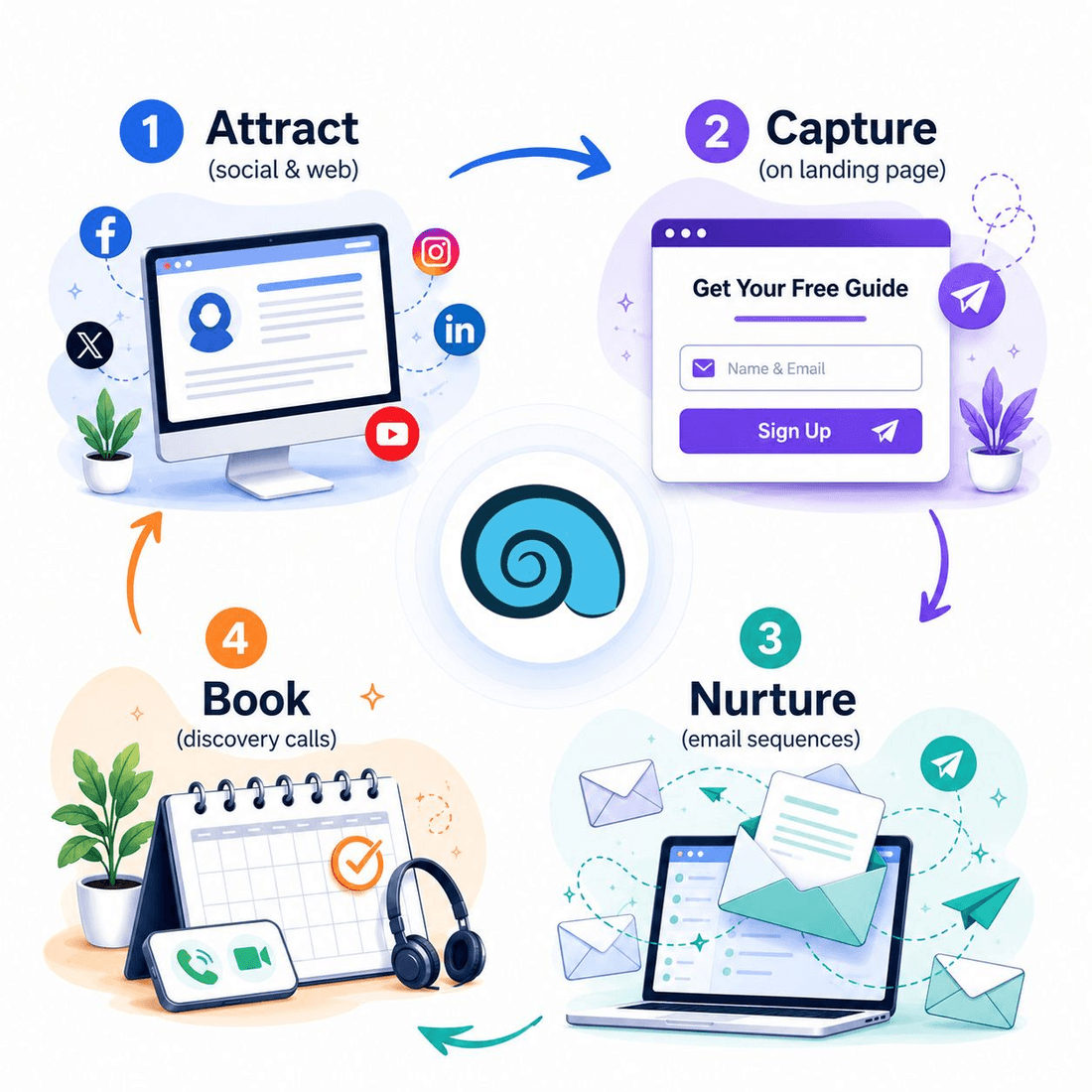
A sales funnel for coaches is the path that turns a stranger into a paying client: someone lands on your page, hands over their email to claim your freebie, gets warmed up by welcome emails, stays in touch through a weekly newsletter, and eventually books a discovery call. Most coaches already have the top of that. What they’re missing is everything after it. 🎯
In this article
What a Coaching Sales Funnel Actually Is
A coaching funnel carries someone from “never heard of you” to “booked a call” without you chasing anyone. It’s called a funnel because more people enter at the top than come out the bottom, and every stage quietly filters for the ones who are actually a fit for your coaching.
Definition: A sales funnel for coaches is the sequence — a landing page where visitors trade their email to claim your freebie → welcome emails → weekly newsletter → discovery call — that turns strangers into subscribers, subscribers into warm leads, and warm leads into clients.
The word doing the work there is sequence. One viral post is not a funnel. A funnel is the machine that catches the attention a post creates and does something useful with it: takes the email, builds trust over weeks, and asks for the call at the exact moment the reader is ready. Once it’s built, it keeps running on the weeks you didn’t post, didn’t feel like marketing, and were booked solid with clients. That’s the whole appeal for a busy coach. The machine works while you coach.
Why a Sales Funnel for Coaches Beats Posting More
If you’re a coach posting five times a week and sending zero emails to a list, you’re leaving money on the table. Most coaches pour everything into the top of the funnel — content, DMs, ads — and then let those leads evaporate because there’s no system to collect and nurture them. There’s a hole in the bucket. Someone follows you, likes a few posts, maybe grabs a freebie, and then nothing. Three weeks later they’ve forgotten you exist.
It’s worse than it looks, because social media is rented land. Organic reach on most platforms sits around 3–8% of your followers. So your 10,000 followers? Maybe 500 of them actually see your post. On a good day. And you don’t write the terms of that lease — the algorithm decides who sees you, how often, and whether the reach you had last year still exists next year.
An email list is an audience you own. No algorithm sits between you and your subscribers — you hit send, it arrives. That’s the difference between renting attention and owning a relationship, and it’s why every funnel that actually works for a coach is built on email, not follows. 📩
The usual fallback makes it worse. When the posts stop landing, coaches start chasing — cold DMs, cold emails, “just checking in if you saw my last message.” I understand the impulse, but every one of those messages quietly repositions you as the person who needs something. Your whole business runs on being the expert, and chasing signals you need clients more than they need you. A funnel flips it back: they raise their hand, they hear from you for weeks, and by the time they book, the discovery call is a formality rather than a pitch. 🎯
None of which means quit social. It’s a fantastic front door, and the coaches I work with keep posting. But the front door has one job: send people somewhere you control. That somewhere is your funnel.

The 4 Stages, and What Each One Does
I’ve built these funnels for coaches across a dozen niches, and the shape never changes. Four pieces. The first two work as a pair to turn a visitor into a subscriber: the freebie is the offer, and the landing page is where the visitor actually claims it with their email. The last two warm that subscriber up until they’re ready. 👇
1. The freebie: one specific problem, solved for free
The freebie is what makes the whole thing work — the valuable thing someone gets in exchange for their email. And it has to be narrow, because nobody hands over their address for “my newsletter.” They hand it over for a fast fix to one problem they have right now. So a good freebie doesn’t cover everything. It solves a single pain point quickly — a checklist, a short quiz, a one-page template, a mini workbook — and delivers a real win in minutes. That quick win does two jobs: it earns the email, and it makes the reader think, “if the free thing is this good, the coaching must be excellent.”
The sharper the problem, the more willing someone is to trade an email to solve it. “My guide to a better life” captures no one. “The 15-minute Sunday reset that ends the Sunday-night dread” captures the exact person you want. Name the thing your ideal client would type into Google at 11pm, make the freebie the answer, then hand them somewhere to claim it. For a menu of ideas by niche, see our guide to lead magnet ideas for coaches.
2. The landing page where visitors claim the freebie
The landing page is where the trade happens, and it’s the only place it can. To get the freebie, a visitor has to land on this page and enter their email. There is no other door. Which is why the page has exactly one job: convince them the freebie is worth an email address, then give them a box to type it into. No navigation menu, no ten other links — a headline, a few lines on the specific problem the freebie solves, one form.
This is the conversion point of the entire funnel, so point everything at it: social traffic, the link in your bio, the podcast mention. Everyone who opts in becomes a subscriber you own. Everyone who leaves without opting in is attention you earned and lost.
3. The welcome emails that do the trust-building
The second someone opts in, your welcome emails take over — usually five or six messages that arrive automatically over the first ten days or so. They deliver the freebie, introduce you, share a client story, and build trust before you ask for anything — I’ve written out welcome email examples for every one of them. This runs on autopilot for every new subscriber, forever.
Done well, they do the emotional work a cold discovery call used to do. The subscriber gets to know you, sees that you understand their problem, and warms to the idea of working together. By the last email, inviting them to book a call feels natural rather than pushy, because you’ve earned it. ✅
4. The weekly newsletter that books the calls
Most subscribers won’t be ready to hire you the week they join. The newsletter is what keeps you in the room for the weeks or months until they are. Each issue gives one useful thing — an insight, a story, a small win — and reminds them a discovery call is there when they want it.
This is the stage coaches skip most, and it quietly does the most work. People hire a coach the week their pain finally outgrows their patience, and you have no way of knowing which week that is. Showing up every week means you’re the one they think of when it arrives. For how automation carries this stage, read how AI email funnels work for coaches.
Want these four stages mapped to your exact niche? Your free custom roadmap shows the freebie, landing page, welcome emails, and newsletter we’d build for your practice — before you commit to anything.
Claim my roadmapFree · No credit card · 3 minutes
A Coaching Funnel Example, Start to Finish
Stages are easy to nod along to and hard to picture. So here’s one running end to end: Maya, a health coach who helps overwhelmed professionals get their energy back.
The stranger
A tired 38-year-old sees Maya’s post about why 3pm energy crashes have nothing to do with willpower. It lands. They tap her bio link.
The freebie and landing page
The link opens a plain landing page: “Get the free 7-Day Energy Reset — one small change a day, no diet overhaul.” One headline, one form. They type their email and hit download. A stranger just became a subscriber.
The welcome emails
Five emails arrive over the next week, automatically. One delivers the reset. Two tells Maya’s own burnout story. Three explains the pattern behind energy crashes. Four shares a client who got her mornings back. Five invites a free discovery call. Nobody pressed send — the funnel did.
The weekly newsletter
Not ready yet, they do nothing — but every week Maya’s newsletter shows up with one useful idea. Nine weeks later, after a brutal deadline sprint, they hit their limit. Maya is in the inbox that morning. They click “book a call.”
The client
On the call, they already trust Maya — they’ve been reading her for two months. It’s a conversation, not a pitch. They sign. She wasn’t convincing a stranger; she was pitching to her tribe. And the same funnel is walking a hundred other subscribers toward the same moment.
The shape holds for a life coach with a clarity journal or a business coach with a revenue audit — only the freebie and the stories change. See how it adapts in our guides to email marketing for life coaches and email marketing for health coaches.

Build It Yourself, or Have It Built
There are two honest ways to get a coaching funnel: build it with software, or have someone build it for you. Both work. The answer depends entirely on whether your scarce resource is money or time.
DIY means assembling tools — a landing-page builder, an email platform, an automation to connect them, something to design the freebie. The software is cheap and genuinely capable. But the tools were never the hard part. The hard part is writing the freebie, drafting the welcome emails, and producing a newsletter every week in a voice that sounds like you. For a coach whose calendar is already full of clients, that writing is the bottleneck that never clears.
Done-for-you flips it: a team builds the funnel and sends it, and your only job is to approve. You pay more per month and get all your time back. A coach I spoke with last month put it perfectly: “I don’t want a better kitchen. I want someone to cook dinner.” If you enjoy running your own marketing, DIY is a fine fit. If you’d rather coach, that’s the whole reason services like Nautilus exist.
Where Coaching Funnels Break
Funnels fail in a handful of predictable ways. Here are the ones I see over and over, and the fix for each. ⚠️
No freebie at all. Sending social traffic straight to a “book a call” page skips the trust entirely. Almost nobody hires a coach they met thirty seconds ago. Get the email first.
A freebie that’s too broad. “Everything you need to know about wellness” loses to one sharp quick win every time. Narrow beats comprehensive.
A cluttered landing page. A full menu and five competing links give visitors five ways to leave. One page, one offer, one form.
No welcome emails. Taking an email and then going silent wastes the warmest moment in the funnel. Subscribers are never more interested than on day one.
Quitting the newsletter after two issues. This is the big one. Most sign-ups convert weeks or months later, and only if you’re still there. Consistency fills the calendar, not intensity.
Never inviting the call. A funnel that gives value forever and never asks is a hobby, not a system. Make the invitation, clearly and often.
Letting the emails land in spam. If they don’t reach the inbox, none of the above matters. The behind-the-scenes setup is easy to get wrong — get it handled once and stop thinking about it.
How Nautilus Builds Your Funnel for You
Reading about a funnel is easy. Building all four stages, then feeding the newsletter every single week, is where coaches stall. Nautilus takes that off you entirely: AI plus a real team builds and sends the whole funnel, and your only job is to approve.
You tell us about your practice
Who you help, what problem you solve, how you talk about it. A few minutes is enough for us to learn your niche and your voice.
We build the whole funnel
Freebie, landing page, welcome emails, weekly newsletter — drafted by AI, refined by a real team so it reads like you, and wired together end to end.
You approve, we send
Every newsletter shows up as a ready-to-send draft. Approve it in two minutes or let it go — either way the emails keep going out on the weeks you’re booked solid.
Landing in the inbox, handled
You never open a settings page or wonder why an email bounced. Everything behind the scenes stays our job, quietly, forever.
One flat plan at $199/mo, everything included, with a 30-day money-back guarantee on your first month. No trial to cancel, no dashboard to learn. The best funnel is the one that actually ships and keeps running — for most coaches, that means handing it to a team. Start from the main hub, done-for-you email marketing for coaches, or see what’s included on our pricing page. 🎯
Entrepreneur | Co-founder @ Nautilus, the done-for-you email marketing service for coaches & consultants. I write about email marketing, funnels, lead generation and everything I learned during the past 15 years building businesses, writing software and generating leads in the digital world.
Frequently Asked Questions
What’s the difference between a sales funnel and an email funnel?
A sales funnel is the whole journey from stranger to paying client — including where people first find you and where they finally book a call. An email funnel is the stretch of that journey that runs inside the inbox: the freebie, the welcome emails, the newsletter. For coaches, the email funnel is the engine. It does most of the work inside the larger sales funnel.
How long does it take to build a coaching funnel?
Built yourself, a few weeks of part-time work: creating the freebie, writing the landing page, drafting the welcome emails, wiring up the newsletter and the automation. Done for you, it is days rather than weeks — with Nautilus you spend a few minutes telling us about your practice, a team builds all four stages, and you approve.
Do I need paid ads to run a coaching funnel?
No. Plenty of coaches fill their funnel with organic traffic alone — social posts, a podcast, a bio link, referrals — all pointing at the landing page. Ads buy speed, not necessity. The funnel works the same either way: it captures the email, nurtures the subscriber, and books the discovery call no matter how the person arrived.
What’s the best sales funnel for a new coach?
The simplest complete one. A single sharp freebie, a focused landing page, a short welcome sequence, and a weekly newsletter that invites a discovery call. Do not over-engineer it with multiple offers and branching logic. One freebie and consistent emails will beat an elaborate funnel you never finish, and you can add sophistication later once it is working.
How much should a coaching funnel cost?
Build it yourself and the software runs from a low monthly fee to a couple hundred dollars a month across several tools — plus a lot of your own hours. An agency to build and run it typically charges $500 to $5,000 a month. Nautilus is one flat plan at $199/mo with everything included and a 30-day money-back guarantee on your first month, which is why coaches compare us to agencies rather than software.
How do I create a marketing funnel for coaching services?
Start at the end and work backwards. Decide the one thing you want someone to do — for most coaches that's book a discovery call — then build only the four pieces that lead there: a freebie that solves one specific problem, a landing page where a visitor trades their email to claim it, a short run of welcome emails that earns trust, and a weekly newsletter that keeps you present until they're ready. Build them in that order, and don't add a fifth piece until those four are actually running.
Get Your Whole Funnel Built for You
Tell us about your coaching practice and we’ll show you exactly what we’d build — freebie, landing page, welcome emails, weekly newsletter — in your voice.
Claim my roadmapFree custom roadmap · No credit card · 30-day money-back guarantee on your first month