Email Marketing for Realtors: The 2026 Guide to Automated Client Nurturing
That lead from your open house last month? They just bought a house—from someone else. Here's how to make sure that never happens again.

The Silence Problem: Where Leads Go to Die

You know the feeling. You meet someone at an open house, have a great conversation, exchange information—and then life happens. Three weeks later, you realize you never followed up. By then, they've forgotten your name and found another agent.
Here's the math that should terrify every real estate agent: The National Association of Realtors reports that 64% of home sellers found their agent through a referral or used an agent they'd worked with before. That means nearly two-thirds of your future business depends on people remembering you.
The average homebuyer takes 6-12 months from first search to closing. If you're not staying in touch during that entire window, you're handing your competitors a six-month head start.
The problem isn't that you don't want to follow up. It's that you're too busy actually selling houses to manually nurture every lead. Between showings, negotiations, inspections, and closings, consistent communication falls to the bottom of the list.
This creates three devastating problems for your real estate business:
- Lost leads — Interested buyers and sellers forget about you and find someone else
- Missed referrals — Past clients don't think of you when friends ask for agent recommendations
- Constant prospecting — You're always hunting for new leads instead of harvesting existing relationships
The agents who build sustainable, referral-based businesses have one thing in common: they've systematized their follow-up so it happens automatically, whether they're at a closing or on vacation.
Why Email Beats Social Media for Real Estate

"But I post on Instagram every day!" Look, social media has its place in real estate marketing. It's great for brand awareness and showing off listings. But here's what most agents don't realize: you don't own your social media audience.
Instagram's algorithm decides who sees your posts. Facebook can change the rules overnight. Your 10,000 followers might as well be zero if the platform decides your content isn't "engaging" enough.
Email is different. When someone gives you their email address, you have a direct line to their inbox—no algorithm in between. And the numbers prove it works:
Email vs. Social Media for Real Estate
Email Open Rate (Real Estate)
35-40%
Instagram Post Reach
5-10%
Email Click Rate
3-5%
Social Media Click Rate
0.5-1%
Source: DMA Email Benchmarking Report 2025, Sprout Social Index 2024
Beyond the numbers, email offers something social media never can: depth. A Instagram post gets three seconds of attention. An email gets 30 seconds to three minutes. That's enough time to actually provide value—market insights, homeowner tips, neighborhood updates—that positions you as the local expert.
The smart agents use both channels strategically: social media for awareness and personality, email for relationship-building and conversion. But if you had to choose one, email wins every time for turning contacts into closings.
What to Actually Send Your List
Here's where most realtors get stuck. They know they should email their list, but they sit staring at a blank screen thinking, "What do I even say?" Week after week, nothing gets sent because the content hurdle feels too high.
The solution is simpler than you think. Your newsletter doesn't need to be groundbreaking—it just needs to be valuable, consistent, and personal. Here are the content types that work best for real estate agents:
Market Updates
Monthly local market snapshots—median prices, days on market, inventory levels. Position yourself as the market expert.
Homeowner Tips
Seasonal maintenance reminders, home value tips, renovation ROI insights. Valuable for past clients and future sellers.
Local Highlights
New restaurants, community events, school updates. Show you know the neighborhoods you serve inside and out.
Buyer/Seller Guides
First-time buyer checklists, selling timelines, mortgage rate updates. Educational content that builds trust.
Success Stories
Client testimonials, recently sold homes, transaction highlights. Social proof that you get results.
Seasonal Content
Spring selling tips, fall market forecasts, holiday-themed home staging. Timely content that feels relevant.
Pro tip: You don't need to create all this content yourself. AI-powered newsletter tools can generate market-relevant content tailored to your audience, then you just review and send.
The Three Audiences Every Realtor Needs to Nurture
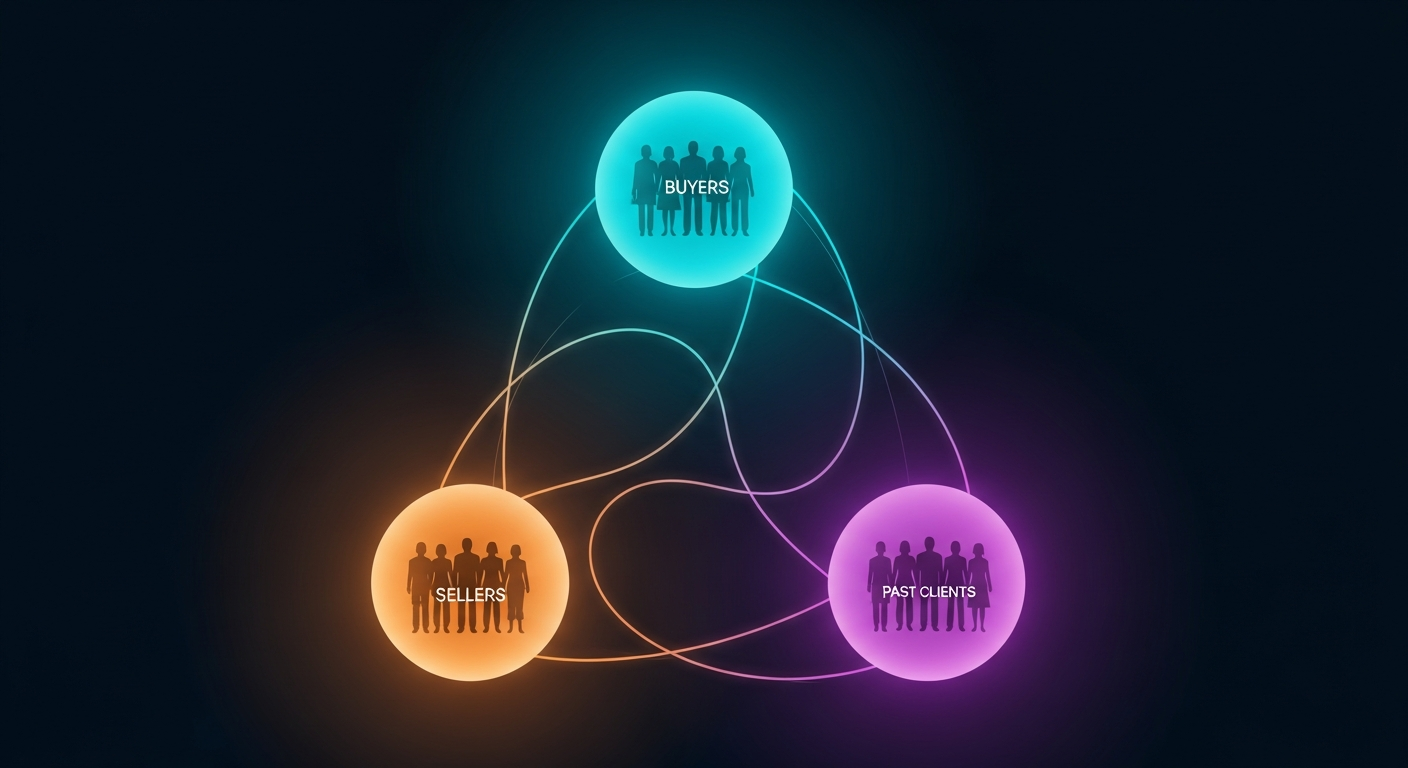
Not everyone on your email list is the same. A first-time buyer researching neighborhoods has different needs than a past client who closed three years ago. The most effective real estate email strategy recognizes three distinct audiences:
Active Buyers
These leads are actively searching but haven't committed to working with you yet. They need frequent value to stay engaged and choose you when they're ready.
Content focus: New listing alerts, market updates, buyer tips, mortgage rate news
Frequency: Weekly or bi-weekly
Potential Sellers
Homeowners who might sell in the next 1-2 years. They need to see you as the local market expert before they're ready to list.
Content focus: Home value updates, renovation ROI, staging tips, local sales data
Frequency: Monthly
Past Clients & Sphere
People who've worked with you before or know you personally. They're your referral engine—if they remember you when someone asks for an agent.
Content focus: Homeowner tips, local events, personal updates, anniversaries
Frequency: Monthly to bi-monthly
The good news? You don't need three separate newsletters. A well-crafted monthly newsletter with market updates, homeowner tips, and local content serves all three audiences. The key is consistency—showing up in their inbox month after month so you're always top-of-mind.
How to Automate Without Losing the Personal Touch
"But won't automated emails feel impersonal?" This is the fear that keeps many agents from automating their follow-up. And it's valid—nobody wants to receive robotic, generic marketing.
The secret is this: automation handles the mechanics, you provide the personality. The best automated newsletters don't feel automated at all. They feel like a personal update from someone who knows the market.
Here's how to automate your real estate email marketing the right way:
Choose the Right Tool
Traditional email platforms like Mailchimp require you to write every email. Look for AI-powered tools that can generate market-relevant content automatically. You should review before sending, but the heavy lifting is done for you.
Set Your Schedule
Decide on a consistent sending cadence—monthly works for most agents. The system handles the scheduling, so newsletters go out even when you're busy with closings.
Add Your Voice
Before each newsletter sends, review the content and add personal touches. A quick note about a recent closing or local observation makes it feel authentic.
Capture Leads Automatically
Use landing pages at open houses to capture visitor emails. Once they sign up, they automatically receive your newsletters—no manual data entry or follow-up reminders needed.
Track What Works
Monitor your open rates and click rates. See which content resonates and adjust accordingly. If market updates get more clicks than homeowner tips, lean into that.
The Time Math
Traditional email marketing
4-6 hours/month
Writing, designing, sending, tracking
AI-automated newsletters
15-30 minutes/month
Quick review and personalization
That's 4-5 hours back in your month—time you can spend showing houses, building relationships, or actually taking a weekend off.
Getting Started Today
You don't need a massive email list to start. Even 50 contacts—past clients, open house visitors, sphere of influence—is enough to begin building the habit of consistent communication.
Here's your action plan for the next 48 hours:
Today: Export your contacts from your CRM, phone, and past transaction records
Tonight: Sign up for an AI newsletter tool and upload your contacts
Tomorrow: Review your first AI-generated newsletter draft and hit send
Next week: Add a landing page to capture new leads at your next open house
Within 30 days, you'll have a system that keeps you top-of-mind with every contact—automatically. No more forgotten follow-ups. No more lost leads. No more watching deals go to agents who simply stayed in touch.
Stop Losing Leads to Silence
Nautilus writes, designs, and sends professional real estate newsletters automatically. Stay top-of-mind with every lead without adding another task to your plate.